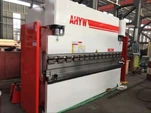
Top&Bottom Bending Tools For Press Brakes
When using dies for bending metal parts, the bending angle of the upper punch and lower die of the bending machine is consistent with sheet profiles, When the pressure on the plate reaches a certain degree, reduce the area of the non bending part of the plate. According to the pressure formula F = P.S, reduce the area of the non bending part of the plate.
The scheme is that when the steel plate is bonded on the die surface outside the bending deformation area on the upper die side or the lower die side of the bending machine, any number and width of transverse through shallow grooves are opened on the die surface to maximize the pressure on the bending part of the plate and realize the full plastic deformation of the bending part of the material.
When the slotted bending die is used for bending, because the non bending pressure bearing area is much larger than the area of the bending part, the bending pressure can be reduced by more than 50%. There is no need for a bending machine with large tonnage, high rigidity and complex functions. It is an ordinary NC bending machine that processes workpieces by air pressure method. It not only saves energy, but also reduces equipment investment. The precision of one-time molding and high production efficiency provide basic conditions for automatic and intelligent production.
The upper die of the bending machine adopts the slotted bending die, and the plate is bent by the molding method, which can improve the technical level and quality level of plate production, especially the precision plate production. The slotted bending die can expand the molding thickness of the plate to more than 1mm. For medium and thick steel plates, large-size workpieces can also be processed, and the pressure acting on the die is greatly reduced to ensure safe operation. The slotted bending process can be applied to unilateral bending dies at any angle and at any angle, and can also be used for special slotted bending dies for one-time forming.
How To Choose the Correct Bottom Dies?
The selection principle of bending L-shaped workpiece is that there are no rules, and almost any upper die can be used. Therefore, when selecting the lower die of bending machine for sheet bending workpieces, L-shaped workpieces can be considered finally, because almost all lower dies of bending machine can bend them. When bending these L-shaped workpieces, it is recommended to use the lower die of the bending machine that can also bend other workpieces instead of buying unnecessary dies. Remember, when you buy a mold, try to buy as few as possible. This can not only minimize the mold cost, but also reduce the number of molds required, so as to shorten the installation time.
Special die selection rules are required for workpieces of other shapes. For example, when forming a J-shape, the rules are as follows:
When the upper section of the work piece is longer than the lower section, a gooseneck die is required; When the upper and lower sections of the workpiece are short, the lower die of any bending machine can be used; When the upper and lower sections of the workpiece are equal in length, the lower die of the bending machine needs to be used. In short, the upper die selection principle mainly depends on the workpiece interference, which is where the bending simulation software can play an important role. If the system used cannot simulate the bending state, the lower die workpiece of the bending machine can be checked manually by using the drawing with grid line.


If a conventional press brake die is used, the elbow section or Z-shape needs to be bent twice. Constituted according to the following rules:
Bending twice
The middle part (groove) must be larger than half the width of the V-die body; Please note that it is the overall width of the V-shaped lower die. The side must be shorter than the height of the V-shaped lower die, plus the lifting height. If the middle section (WEB) is less than half the width of the V-shaped die, a special die is needed to make the lower die of the bending machine form two bends in one stroke. The advantage of this kind of special die is that it does not need a turnover plate, but the disadvantage is that the bending force is about three times.