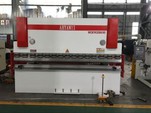
Small Parts Bending On CNC Pressbrakes
Running a cnc press brake while forming smaller, complicated parts hasn’t been the safest job for fabricator, especially if that operator worked on old cnc press brakes without modern safeguarding. Press brake Operators bending a small piece often have no choice but to position their hands very close to the bending tooling.
Press brake operator should be able to support small workpieces from underneath, sliding the tiny blank against the backgauge with their thumbs and fingers safely away from pinch points. CNC press brake with light curtain guarding might see those fingers as an obstruction and stop the operation as a safety precaution. Some parts might be so small that, on some equipment, the only safe way an operator can bending them is to position the blank on the tool and use palm buttons to actuate the ram. Left unsecured, the blank might not be flush against the back gauging surfaces, which puts the bend in a slightly different location. This can throw the part out of tolerance, which in turn makes the whole operation less efficient.

Sometimes you need to put a small part on a large press brake can find the job stressful and even intimidating. And if working with an older pres brakes without any safety guarding, an operator (especially a tired one) with fingers too close to the bend line raises serious safety concerns, light curtain still some issues.
Then comes the production inefficiencies, the most obvious being the problem of using the wrong manufacturing technology for the job, like a massive press brake for a tiny part. Forming small part after small part on a large press brake can be a serious choke point, stealing resources that could be better utilized for larger work.
If accuracy issues arise, especially considering the narrow, acute punch tools small workpieces often require. Air bending over an acute die produces a small radius and a setup that in general can be susceptible to angle variation. When some bending operations might resort to bottoming to achieve a repeatable angle, especially on older machines, but this introduces more tool wear as well as concerns about Max sheet metal bending tonnage, especially if the operator uses a die width too narrow for the application.
Even without any bending accuracy problems, press brakes operators still have to deal with handling numerous small parts. Consider the entire sheet profiels bending cycle, not only the ram movement (which can be slow on older hydraulic machines), but also the moves operators perform as they bending one small piece after another.

When small parts need to be bending within very tight tolerances, an press brake operator has little room for error. Problems with precision often start with bad back gauge support system. An bending machine operator sometimes can have trouble sliding a very thin, small part securely against a backgauge. If the piece sits ever-so-slightly askew, the initial bend line can be slightly off, and the tolerance deviations stack up from there.
But modern CNC controlled powerful bending back gauge can help here, let's see 4 axis or 5 axis auto bending backgauge that moves in Z1 and Z2 for staged setups using multiple toolsets. It also moves in R (back gauge running from up to down) which can be critical for guiding a workpiece through bump-forming. The backgauge position along the R axis helps the operator maintain a consistent pitch (distance between bumps) throughout the entire bumped radius when bending Radius sheet profiles.
CNC Press brakes back gauge moves in X, of course (toward and away from the tooling), but it can also move in delta X1, which can have a finger attachment that can be moved in and out independently. Sometimes when bending very small parts, some operations use the X axis as a backgauge and the delta-X axis as a side-gauge. Also you can customzied 6 axis cnc powerful back gauge as Z1,Z2,X1,X2,R1,R2, each finger stop can move in different directions separately for bending complicated parts.

Ball-screw-driven CNC electric press brakes offerhigher positioning accuracy. Ever-so-slight overtravel of the ram can wreak havoc on precision, small-piece forming work.
Also CNC electric press brakes offer higher bending speed and acceleration. Near immediate acceleration and deceleration means Pressbrake operator isn’t waiting for top beam to achieve its working speed. This becomes even more important for small parts, where top beam travel can be minimal. That immediate acceleration also means the bend program can maintain minimal open heights.
Sheet metal bending is only a series of processing processes for metal materials, such as bending, riveting and welding. Next, we will talk about the causes and solutions to the problems encountered in the bending process of sheet metal processing.
Problem 1: the outer surface of the workpiece is scratched after bending.
[reason]
1. The surface of raw materials is not smooth;
2. The bending radius of punch is too small;
3. Bending clearance is too small.
[solution]
1. Improve the smoothness of punch and die;
2. Increase the bending radius of punch;
3. Adjust the bending clearance.
Problem 2: the bending edge is not straight and the size is unstable.
[reason]
1. No line pressing or pre bending is arranged for the design process;
2. Insufficient material pressing force;
3. The wear of round corners of punch and die is asymmetric or the bending force is uneven;
4. The height dimension is too small.
[solution]
1. Design line pressing or pre bending process;
2. Increase the pressing force;
3. The clearance between punch and die is even and the fillet is polished;
4. The height dimension cannot be less than the minimum limit dimension.
Problem 3: bending causes hole deformation.
[reason]
When the elastic bending is adopted and the hole is positioned, the outer side of the bending arm is pulled due to the friction between the die surface and the outer surface of the workpiece, which deforms the positioning hole.
[solution]
1. Adopt shape bending;
2. Increase the pressure of the ejector plate;
3. A pitted grid pattern is added on the ejector plate to increase the friction and prevent the workpiece from sliding during bending.
Problem 4: there are cracks in the bending angle.
[reason]
1. The inner radius of bending is too small;
2. The material grain direction is parallel to the bending curve;
3. The burr side of the blank is outward;
4. Poor plasticity of metals.
[solution]
1. Increase the bending radius of punch;
2. Change blanking layout;
3. The burr is changed into the fillet of the workpiece;
4. Anneal or use soft materials.
Problem 5: the hole position and dimension accuracy cannot be guaranteed after bending.
[reason]
1. The unfolding size of the workpiece is incorrect;
2. Caused by material rebound;
3. Positioning is unstable.
[solution]
1. Accurately calculate the blank size;
2. Add correction process or improve bending die forming structure;
3. Change the process processing method or increase the process positioning.
Problem 6: uneven bottom of concave part.
[reason]
1. The material itself is uneven;
2. Small contact area between top plate and material or insufficient jacking force;
3. There is no ejector in the die.
[solution]
1. Leveling materials;
2. Adjust the jacking device to increase the jacking force;
3. Add jacking device or correction;
4. Plus shaping process.