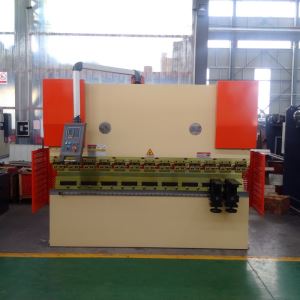
How To Start Bending Parts On CNC Pressbrake
If you are just starting using or operating a press brake, ask yourself these questions from the start to establish best bending performance: Do you know the safe working limits of your CNC Press brake and bending tooling? Do you have the right bending tools to make repeatable bends?
When purchasing first press brake, shop managers ideally should establish best practices right from the start. What are the safe working limits of the machine and its tooling? What should the maintenance procedures be, and whom can you call should a crisis arise? What tooling do you need to make quality, repeatable bends?
Not every question that follows comes from a shop new to the press brake. Regardless, they all address problems many in this industry face, newbies and veterans alike.

How To Calculate and Determining Safe Bending Parameters On CNC Press brakes
First you need to know manufacture, bending pressure power, Max bending laoding, tooling parameters, also bending central-line loadingThe centerline bending limit is the tonnage value that you do not want to exceed as doing so will lead to ram upset.
Also you need to know your press brake tooling Max loading capacity. Considering the tonnage rating of your pressbrake, Max tooling laoding limitations might not be an issue. Regardless, if this is your first press brake and you’re looking to add more in the future, identifying your tooling load limits is a good practice to establish.
CNC Higher Precision-ground tools come with a tonnage rating from the factory. You will find the rated sheet bending tonnage for that specific press brakes tool on the tool itself. This can change depending on the press brake bending tooling type and geometry. For instance, a deep gooseneck punch will likely have a lower tonnage limit than a typical straight punch—though, again, the exact limit will depend on the tool’s geometry and overall design.
If you can not find the correct bending tooling loading limitation, you need to check it out with your press brake supplier or tooling supplier, inform them your sheet profiles bending requirements and they can determine which press brake tools will be suitable for your sheet metal bending profiles.
You may want to calculate metal bending profiels required tonnage based on the material tensile strength and the die opening. The formula normally using is as follows and will give you the tonnage per inch that you’ll then multiply by the length of the bend in inches:
Required forming tonnage per inch = [{(575) × (Material thickness2)/Die opening}/12] × Material multiplier × Forming method multiplier
For the forming method multiplier, insert 1 for air forming (the baseline method), 5 for bottom bending, and 10 for coining. For the material multiplier, insert 0.50 if you’re forming 5052 H32 aluminum, 1.4 if you’re forming 304 stainless steel, and 1.0 if you’re forming 60,000-PSI tensile-strength mild steel, carbon steel sheet.
If you are bending other steel material, like stainless sheet, Hardox steel, simply divide the tensile strength for the material you’re forming by the baseline material’s tensile strength (60,000 PSI). So, if your material has a tensile strength of 120,000 PSI, you’d have a material multiplier of 2.0 (120,000/60,000 = 2.0).


In certain circumstances, you might need to incorporate another factor into the equation. This factor accounts for tools that make multiple bends simultaneously, such as offset and hat tools. I cover this topic in “The 4 pillars of press brake tonnage limits,” butpress brakes tooling supplier should be able to offer guidance here as well. Again, if you’re just starting out, you’re probably not using special tools like offset tools. But if you’re establishing best practices for future growth, then noting the tonnage requirements for these tools isn’t a bad idea.
Losing Bending Pressure after long time bending
First, you need to check whether the bending material the same? That is, are you bending not only the same thickness but also the same material type? You may have ordered the wrong type of sheet bending material, or your supplier may have substituted a different material. If the tensile strength has increased, bending the workpiece may require more force than your bending machine can produce.
If the material is correct, look at the hydraulic system next. Have the oil filters been changed recently? Are the oil filters partially plugged, reducing the flow to the cylinders, thus reducing the power? Is the oil old or dirty? Hydraulic oil needs to be replaced?
Whether your CNC press brake running hot? If the press brake oil is heat up, it can become thin and reduce the power at the cylinders. If that’s the case, try adding an oil-cooling radiator to the system to make it run cooler.

Assuming that the oil is new, the filters are clean, also your cnc press brake isn’t running hot, check the pressure at the oil pump. Is it producing enough pressure to allow the press brake to function? If it is producing enough pressure from oil pump, move on to the proportional valving system. Are you getting equal pressure out both sides of the valving unit? If so, move on to the cylinders. Are they leaking badly and losing pressure? Has it leaked to the point that the machine does not have enough hydraulic oil to function and is perhaps overheating as a result?
If you answer all these questions and still don’t know what’s causing cnc press brake losing bending pressure issues. You may one engineer support from the cnc press brakes manufacture or dealers.