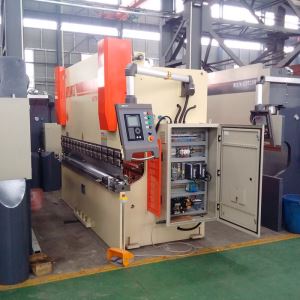
CNC Press Brake Operating In Elevator Production
The application of high-precision CNC Press brake in the elevator production industry: The elevator is mainly composed of a three piece set of door panel and wall panel (front wall - operating wall - door lamp beam - ceiling decoration roof and other parts. The material is generally 1.0~2.0mm stainless steel plate or cold-rolled carbon steel plate. The processing route is generally using shearing machine cuts the material, then the punching machine punches the hole, or the laser cutting the hole, finally using CNC Press brake bending the profiles.
High precision CNC Press brake For Bending Stainless Elevator
In order to ensure the product quality in the full bending process, it is necessary to set the minimum bending radius, minimum bending straight edge, minimum hole edge distance and other extreme values. Different plates have different minimum bending radius due to their different elongation. The minimum bending radius of the commonly used sheet metal, T is the thickness of the sheet metal.
The minimum bending straight edge refers to the distance between the plate boundary and the bending edge. If the length is too small, it may cause bending deformation, or even damage the press brake tooling system. The distance is generally h>2t.
Hole edge distance refers to that in the process route of punching before bending, if the hole position is in the bending deformation area, the hole will be deformed when bending. When t ≤ 2mm, hole edge distance S ≥ t+r; When t ≥ 2mm, hole edge distance S ≥ 1.5t+r.
The bending sequence of CNC Press brake bending sheet metal profiles
Bending sequence is also an important content when formulating bending routing. Improper bending sequence may lead to large deviation of the forming size of the part, or even interference, resulting in failure to complete the bending.
The bending process generally follows the following four basic principles: ⑴ Bending from inside to outside; (2) Bending from small to large; (3) First bend the special shape, then bend the general shape; (4) The former process will not affect or interfere with the subsequent process after forming. For example, when bending the operating wall, its bending follows the principle of "from inside to outside". Normally the current CNC Press brake adopting2D Graphical CNC bending controller with software, bending profiles engineer can make the sheet metal profiles in 2D bending software, then CNC bending will get auto bending sequence according to the drawing imported, it will be big help for operator choose the correct press brake tooling system and bending sequence for get correct bending parts, also will verify sheet metal bending parts designing whether it’s available for bending&forming.
Common problems and solutions of high-precision CNC Press brake
When potential problems are found during bending, they shall be optimized and solved in time. In the elevator car bending process, there are mainly the following problems.
The forming dimension is inconsistent with the drawing
The main reasons for the discrepancy between the forming size of the workpiece and the drawing are the error of the blanking size, the inaccurate bending positioning and the cumulative error of multiple bends. The solution is: adjust the bending coefficient and recalculate the developed size; Adjust the positioning; Select reasonable positioning datum to eliminate accumulated error. If the blanking size error and bending cumulative error are within the allowable range, the forming size can be guaranteed first, and the error can be accumulated to the non assembly edge that has no impact on the workpiece.
Bending angle deviation of CNC Press Brake
If the bending angle of the workpiece is too large or too small, it is easy to cause the bending angle deviation. The main reasons are that the V port of the lower die is not suitable, the springback compensation parameter of the die is not set properly, and the bending machine pressure is not matched. The solution is to select the appropriate lower die according to the bending die table, adjust the rebound compensation value and the bending machine pressure.
Cracks on the bending edge of CNC Press brake
The main reasons for the cracks on the bending edge include that the bending radius is too small, the plate grain is parallel to the bending line, the burr side of the blank is outward, and the material plasticity is poor. The solutions are: increase the bending radius, use high-precision CNC press brake or carry out groove planing; Change the opening and layout direction of the workpiece; Change the direction of the burr and place it on the fillet of the workpiece; Replace the materials with good plasticity.