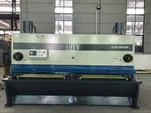
For most of sheet metal fabrication shops or company, sheet metal cutting shears and metal bending machines are the common metal machinery they are using, which they use metal shears to cutting square shape and use metal pressbrakes to bending different metal profiles with different pressbrake tools. But now more and more sheet metal fabricating jobs requiring laser metal cutting machines for cutting different metal shapes, laser cutting machine can cut different holes wihout any punch tools which adopted by Metal Turret Punching machines.
Sheet Metal Fiber Laser Cuting Machines:
Sheet metal can be cut in various ways, from hand tools called tin snips up to very large powered shears. With the advances in technology, sheet metal cutting has turned to computers for precise cutting. Many sheet metal cutting operations are based on computer numerically controlled (CNC) laser cutting or multi-tool CNC punch press.
CNC laser involves moving a lens assembly carrying a beam of laser light over the surface of the metal. Oxygen, nitrogen or air is fed through the same nozzle from which the laser beam exits. The metal is heated and burnt by the laser beam, cutting the metal sheet. The quality of the edge can be mirror smooth and a precision of around 0.1 mm (0.0039 in) can be obtained. Cutting speeds on thin 1.2 mm (0.047 in) sheet can be as high as 25 m (82 ft) per minute. Now most popular are fiber laser cutting machines
Hydraulic Pressbrake for sheet metal bending or forming
This is a form of bending used to produce long, thin sheet metal parts. The machine that bends the metal is called a press brake. The lower part of the press contains a V-shaped groove called the die. The upper part of the press contains a punch that presses the sheet metal down into the v-shaped die, causing it to bend.There are several techniques used, but the most common modern method is "air bending". Here, the die has a sharper angle than the required bend (typically 85 degrees for a 90 degree bend) and the upper tool is precisely controlled in its stroke to push the metal down the required amount to bend it through 90 degrees. Typically, a general purpose machine has an available bending force of around 25 tonnes per metre of length. The opening width of the lower die is typically 8 to 10 times the thickness of the metal to be bent (for example, 5 mm material could be bent in a 40 mm die). The inner radius of the bend formed in the metal is determined not by the radius of the upper tool, but by the lower die width. Typically, the inner radius is equal to 1/6 of the V-width used in the forming process.
Metal pressbrake usually has some sort of back gauge to position depth of the sheet bending proflies. The metal bending backgauge can be computer controlled to allow the operator to make a series of bends in a component to a high degree of accuracy. Simple machines control only the backstop, more advanced machines control the position and angle of the stop, its height and the position of the two reference pegs used to locate the material. The machine can also record the exact position and pressure required for each bending operation to allow the operator to achieve a perfect 90 degree bend across a variety of operations on the part.
Press brake bending is a different machine.